
Dr Gaurav Gharde and Professor Alice Larkin, colleagues from the Tyndall Centre at the University of Manchester, travelled from the UK to Antalya by train, demonstrating that lower-carbon alternatives are possible, even if far from straightforward. Their reflections focus on witnessing the COP process at first hand: the frustrations of three decades of climate negotiations, the influence of vested interests, and the stark contradiction between the scale of the climate emergency and the woefully inadequate response of governments.
_________________
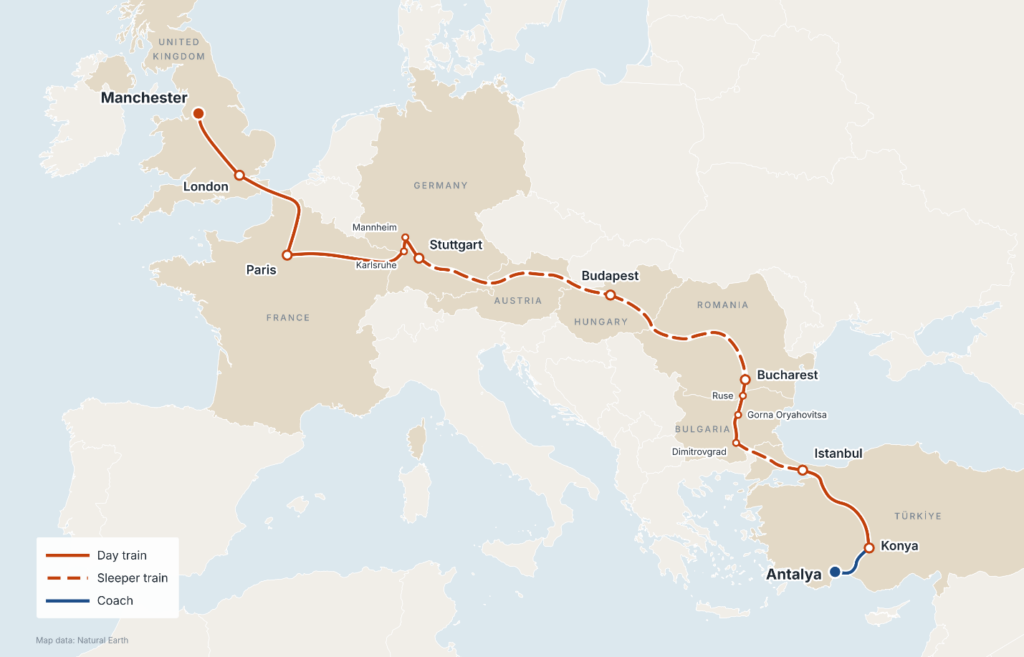
It takes five days to reach Antalya from Manchester without flying. Our journey took us through France, Germany, Austria, Hungary, Romania, Bulgaria and Türkiye, before a coach ride to Antalya. For Gaurav this is a first COP in person as an observer, after having followed four online; Alice first travelled to a COP, again by train, in 2013. Five days on the train gave us plenty of time to talk, and our conversations repeatedly returned to one central question: what should we expect from COP31, when the previous thirty COPs have so fundamentally failed to halt the rise in global emissions?
Three decades of delay and a shrinking carbon budget
Since adopting the UN Framework Convention on Climate Change in 1992, governments have negotiated for more than three decades while global carbon emissions have continued to rise, albeit more slowly in recent years. The remaining carbon budget, the carbon dioxide (CO2) that can still be emitted for a given temperature limit, illustrates the dire consequences of this delay.
Based on the estimates of Forster et al. (2026), from January 2027 the budget for a 50% chance of staying below 1.5°C is about 88 billion tonnes of CO2 (GtCO2), equivalent to roughly two years of emissions at current rates. For the Paris Agreement framing of “well below 2°C” (taken as an 83% chance of not exceeding 2°C), the budget is around 500 GtCO2, or less than 12 years at current rates. For the same high chance of staying below 1.5°C, the budget is already exhausted.
The consequences of delay and failure are not abstract: climate change is already costing lives. As COP31 opened, the World Meteorological Organization (WMO) reported that the first nine months of 2026 were 1.47°C warmer than the pre-industrial average, with several opening statements noting this to be “the first COP where we admit the world will exceed 1.5°C”. We go one step further: woefully inadequate mitigation has already failed the stricter of the two Paris temperature commitments. That makes rapidly strengthening efforts to stay “well below 2°C” all the more important. From the beginning of 2027, global emissions will need to fall at almost 8% year on year to stay to meet the 2°C commitment.
Exceedance and the promise of carbon removal
Two prominent aspects of COP31’s mitigation agenda are ‘overshoot’, where 1.5°C is exceeded for several decades before a return to that level, and “35 by 35”, a pledge to increase electricity’s share of global final energy consumption. Both, as currently framed, are deeply inequitable and fall far short of even a Paris-aligned 2°C carbon budget.
Returning temperatures to 1.5°C after overshoot would require minimal CO2 emissions as well as massive, sustained and completely unprecedented levels of carbon dioxide removal (CDR) from the atmosphere. Australian climate and energy minister, Chris Bowen, who is presiding over the negotiations, told the opening plenary that overshooting 1.5°C is now nearly certain. The COP31 Presidency consequently plans to address overshoot in an overarching political statement, or ‘cover decision’, an approach welcomed by the European Union on the opening day.
As a precursor to this statement, the Presidency’s summary of countries’ views, published on 13 November, lists the need to: “limit the size and duration” of overshoot; pursue “rapid, deep and sustained emission cuts”and “accelerate the research, development and deployment of CCUS and CDR”. The latest draft of the ‘cover decision’, the text anticipated to become the agreed outcome of COP31, was issued on 19 November and is expected to change again. It resolves to limit the size and duration of overshoot without saying how or when warming would return below 1.5°C, while welcoming the rapid scaling up of carbon capture and carbon dioxide removal.
Our concern is that ‘overshoot’ was turned from a warning into a plan long ago, when the 1.5°C pathways assessed by the IPCC came to rely on carbon removal at huge scale as a way of avoiding more politically challenging decisions. COP31 now risks writing this plan into a formal decision, further weakening the urgency of the energy transformation. Any serious discussion must also confront the elevated risks of climate tipping points as temperatures exceed 1.5°C, including the very real possibility of consequences that removal and cooling cannot reverse.
The scale of removal further exposes the problem. The UN Environment Programme (UNEP) estimates that lowering the global temperature by just 0.1°C would mean removing around 220 GtCO2, about five years of total global emissions at current rates. Afforestation and reforestation, the principal biological CDR mechanisms, currently take up about 2 GtCO2 annually. At that rate, it would take a century to compensate for just a 0.1°C exceedance, assuming no fossil fuel or deforestation emissions. If, as is increasingly likely, we reach 2°C of warming in the next two decades, that would require five centuries of current biological CDR to return to 1.5°C, again assuming no fossil fuel or deforestation emissions. As the UNEP report warns, afforestation at the scale needed for net-negative emissions is likely to compete with farmland and threaten food security.
As such, most 1.5°C ‘overshoot’ pathways rely on engineered removals, yet, in 2025, such removals stored only 0.5 million tonnes of CO2 (0.51 MtCO2) in geological formations and minerals, or 0.0012% of total CO2emissions. The principal engineered removal methods depend on carbon capture and storage, an industry that, after three decades of promises of large-scale projects, in 2025 captured under 0.03% of fossil fuel emissions. There is little to suggest future projects can be expected to reach the necessary scale in the time available.
While biological and engineered removals will be needed to address some residual emissions, particularly from agriculture, they must complement the deepest possible emission cuts, not substitute for them. The danger lies in embedding plans around removals that remain unproven at scale; every tonne promised for removal in the future risks becoming a license to emit today.
Moreover, even a ‘temporary’ overshoot would fall hardest on those least responsible for climate change. UNEP acknowledges that the impacts of higher temperatures “will not be distributed equally, and some losses will be irreversible even if global temperatures eventually decline”. The African Group of 54 countries, on the opening day of COP31, noted how “every tenth of a degree costs African lives”. Many developing countries also fear being expected to supply the land for large-scale removals. In the same session, India made this point for the Like-Minded Developing Countries, warning that overshoot implies a later decline in warming based on the land and resources of the Global South, and Venezuela said the same for the Bolivarian Alliance (ALBA).
“35 by 35“
The second prominent initiative is the voluntary pledge ‘35 by 35’, which aims to raise electricity’s share of global final energy consumption to 35% by 2035. The share stood at almost 24% in 2023 and existing policies are expected to take it to 28% by 2035.
Electrifying transport, heating and industry is essential for urgently cutting emissions. However, ‘35 by 35’ is too little, too late and lacks the necessary safeguards on how the electricity is generated. A 2035 deadline arrives about six years after the budget for an even chance of 1.5°C is exhausted. Moreover, increasing electricity’s share is no guarantee of lowering emissions. As currently drafted, the pledge does not rule out power generated from coal, oil or gas. Decarbonisation of the power sector must underpin electrification if the pledge is to remain in line with the science.
Nor does a global average electricity target recognise the profound differences in countries’ capacity and responsibility. It places no additional obligation on wealthy nations, which have the resources to electrify much faster. The African Group has opposed setting electrification targets without specifying the means of implementing them. The Like-Minded Developing Countries, who include India, see ’35 by 35’ as crossing one of its red lines and oppose sectoral targets set globally rather than nationally. India, which has declined to sign the pledge, told the summit that equitable access to the remaining carbon budget is “non-negotiable”. Taking the carbon budget and the implications of overshoot seriously would mean wealthy countries going far beyond 35%, ruling out fossil-related routes to electrification and doing so well before 2035.
What an emergency response would require
If the scientific evidence and a broader suite of mitigation challenges and opportunities were more meaningfully engaged with – including by many scientists, industrialists, decision makers and civil society – climate change would be treated as the emergency it is. The question would no longer be how to manage incremental change over decades, but what can be achieved within the space of a single decade, using existing technology, infrastructure and know-how.
For wealthy countries we see three overlapping stages, but all must start now.
First, cut discretionary emissions: with the largest share of emissions arising from the discretionary norms of a higher-income minority, emissions could be rapidly reduced or avoided without affecting anyone’s ability to meet their material and social needs or participate fully in society. Frequent flying, very large and second homes, large and powerful cars, high annual driving distances, second or third cars and other forms of high-consumption living are obvious examples. Reducing these depends on social change among high-consuming groups, without the need to reconfigure infrastructure. The UK decision to sign a statement alongside countries including Kenya, Spain and Tuvalu, supporting levies on polluting sectors to pay for climate impacts, could be a glimmer of hope towards addressing unequal drivers of emissions.
Second, accelerate the roll-out of existing technologies and solutions: for example, home insulation and retrofit, rooftop solar, batteries and a shift towards public transport.
Third, reconfigure energy and transport infrastructure: such as large-scale renewables and energy storage, expanded electricity grids and new bus, tram and rail networks.
For developing countries the priorities are necessarily different, with the UNFCCC already recognising economic and social development and poverty eradication as their “first and overriding priorities”. In the near term this means alleviating poverty by providing more energy, decent housing, health care and secure incomes for the people who have the least.
This is what the right to development means and yet climate impacts are already eroding it. For the poorest, the next few years of development matter far more than promises about the second half of the century.
These differential responses between developed and developing countries are interdependent. Every tonne of emissions from discretionary consumption and high-carbon infrastructure avoided in wealthier nations leaves more of the remaining budget for countries that are still to build their basic services. The finance that developed countries are obliged to provide under Article 9.1 of the Paris Agreement is an essential contribution to those services being built with clean energy.
What we hoped for and what we saw
Five days on trains is a long time to spend travelling just to watch governments negotiate the terms of overshoot and a potential expansion of fossil-fuelled electricity. We came hoping COP31 would treat climate change as the emergency it is, acknowledge plainly how little carbon budget remains to align with the Paris Agreement, and confront what wealthier nations need to forgo so that poorer countries can develop in a positive and low-carbon direction. Having seen the scale of fossil fuel interests here in Antalya, we know COP31 will not come close to delivering any of this. The Kick Big Polluters Out coalition identified about 60 fossil fuel industry groups with delegates at the summit, and 31 delegates from polluting industries who hold places on countries’ official negotiating delegations.
Another striking feature is the number of delegates wearing 1.5°C badges, even though it is now too late to avoid exceeding that level of warming. This is sometimes justified by arguing that many Indigenous communities do not want to abandon hope. However, I (Gaurav, one of the authors of this piece) come from a Dalit community in India and see my own community among those that this argument speaks for. We need to be honest, and that honesty appears to be missing at COP31: nobody should hide behind the suffering of my community, or of other marginalised communities across the world, to justify maintaining false hope. What these communities need is action now to end the fossil fuel use that sustains the high-consumption lifestyles of the wealthy and middle classes in developed countries and of the wealthy in developing countries. After thirty-one COPs there is no carbon budget left for anything less.
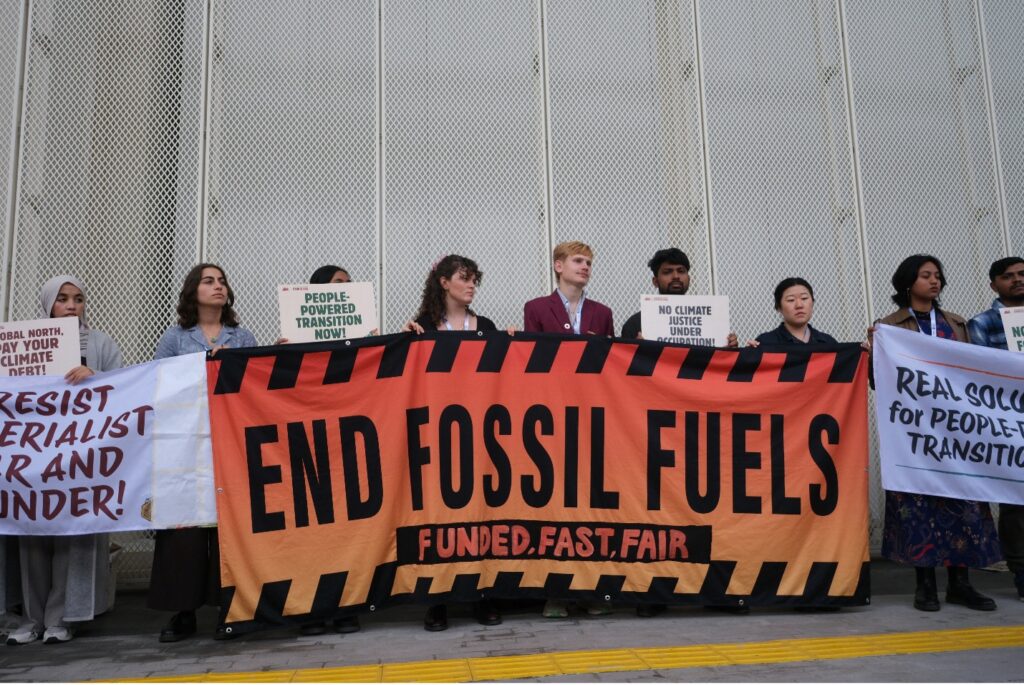
The honest message and hope we did find at COP31 came from protesters holding a banner that read “End fossil fuels” above three words: funded, fast and fair. Those three words sum up the Paris commitments, what the science is telling us and what equitable action means. Nothing will happen without finance from the countries that have emitted the most. The science demands speed on both mitigation and resilience, but critically, the right to development demands fairness. This fairness requires the negotiators to deliver a schedule for the rapid phasing out of fossil fuels altogether – something that won’t be forthcoming in Antalya, where the latest draft of the cover decision fails to mention fossil fuels at all – but perhaps Ethiopia can initiate a new era for action?