
My colleague Dr Dan Calverley and I recently provided a detailed expert report in a landmark case brought by ten Australians before the UN Human Rights Committee. The case challenges the Australian government’s continued support for coal and gas exports and their contribution to climate change and associated human rights harms.
The case comes in the wake of the International Court of Justice’s 2025 advisory opinion, which affirmed governments’ legal obligations to prevent significant environmental and climate harm. Australia subsequently supported a UN resolution endorsing the opinion, alongside 140 other countries.
Our report examines the climate implications of Australia’s fossil fuel exports, providing evidence relevant to the Committee’s consideration of the case.
The full report is available here:
Annex 12: Expert Opinion of Professor Kevin Anderson and Dr Dan Calverley on Australia’s Export Emissions
A summary of the case, with associated links, is available here:
Poelina et al. v. Australia
The BBC also briefly covered the case in June 2026:
Australia’s coal and gas exports violate our human rights, group says in new UN case
Below is reproduced the Executive Summary, Central Finding and Key Messages taken directly from our report.
Executive summary
This report assesses Australia’s projected coal and liquefied natural gas (LNG) exports against the Paris Agreement’s 1.5°C and 2°C temperature commitments, the best available climate science, and the legal framework articulated by the International Court of Justice (ICJ) in its Advisory Opinion on climate change.
The ICJ has confirmed that the Paris Agreement’s objective of limiting warming to 1.5°C provides the relevant benchmark against which state conduct must be assessed. The Court further recognised that states must act in accordance with the best available science and take measures capable of preventing dangerous anthropogenic interference with the climate system.
The best available science indicates that the remaining carbon budget consistent with a 50% probability of limiting warming to 1.5°C is now extremely limited. Assessment of future fossil fuel production and export must therefore be undertaken within the context of rapidly diminishing remaining climate space.
Australia occupies a distinctive position within this framework. While its territorial emissions represent a relatively small share of global emissions, Australia is among the world’s largest exporters of coal and LNG. The emissions resulting from combustion of these exported fuels are several times greater than Australia’s domestic emissions and constitute a significant contribution to global warming.
The central finding of this report is presented in Figure CF1 (see below), which compares projected cumulative emissions from Australia’s future coal and LNG exports under the Australian Government’s two principal export scenarios with Australia’s indicative share of the remaining carbon budgets.
The analysis does not seek to determine Australia’s equitable share of the remaining carbon budget. Instead, it applies a simplified allocation based on Australia’s current share of global fossil fuel exports and excludes considerations that would imply a more stringent allocation, including historical responsibility, national capability, per-capita emissions, and the principle of common but differentiated responsibilities and respective capabilities (CBDR-RC). Figure CF1 therefore constitutes a conservative compatibility test.
The results are unequivocal.
Under both Australian Government export scenarios, projected cumulative export emissions far exceed Australia’s indicative share of the remaining carbon budget. Australia’s projected export pathways therefore fail a conservative compatibility test, constructed using assumptions that significantly favour Australia’s position.
This finding has implications beyond debates concerning burden-sharing or climate justice. Even under a methodology designed to maximise Australia’s permissible contribution to future emissions, Australia’s projected coal and LNG exports remain incompatible with the emissions reductions required to achieve the Paris Agreement’s temperature commitments.
Accordingly, the report concludes that the continued export of Australian coal and LNG cannot be reconciled with a climate pathway consistent with limiting warming to 1.5°C. Nor can those pathways be regarded as consistent with the precautionary framework embedded within the UNFCCC or the standard of conduct articulated by the ICJ.
The conclusion reached in this report should be regarded as a minimum finding. It is derived from a methodology that systematically favours Australia’s position, and that deliberately avoids more demanding interpretations of climate responsibility. Incorporating considerations of historical responsibility, national capability, equity, or CBDR-RC would only strengthen the conclusion reached here.
Central finding
Australia’s projected coal and LNG export pathways are incompatible with the Paris Agreement’s 1.5°C and even the 2°C temperature commitments.
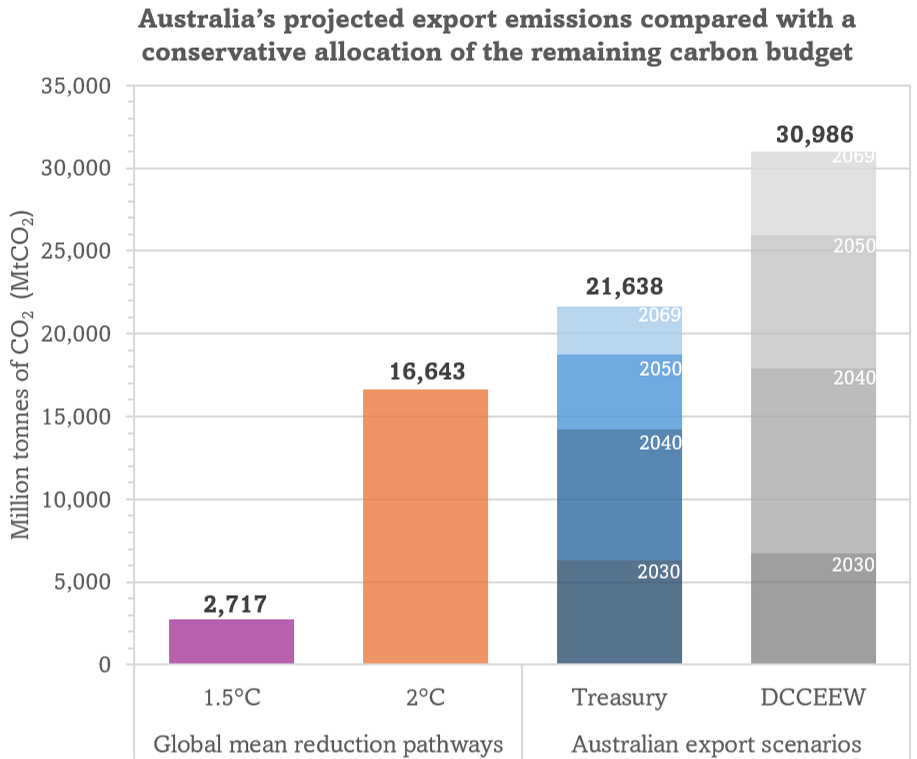
Figure CF1: Stacked column chart of a conservative allocation of 1.5°C and 2°C remaining carbon budgets compared with emissions under the ‘Treasury scenario’ and ‘DCCEEW scenario’ (based on Figure 6 in section 5.7 of this report).
This figure underpins the central finding of this report: Australia’s projected coal and LNG export pathways are incompatible with the UNFCCC’s objective of preventing dangerous anthropogenic interference with the climate system, the Paris Agreement’s 1.5°C and 2°C temperature commitments, and the standard of state conduct articulated by the International Court of Justice’s advisory opinion on the Obligations Of States In Respect Of Climate Change.
This conclusion holds even under assumptions deliberately designed to favour Australia and in absence of considerations of equity, historical responsibility, national capability, and the principle of common but differentiated responsibilities and respective capabilities (CBDR-RC).
Key messages
The ICJ has established 1.5°C as the relevant benchmark for state conduct.
The ICJ’s Advisory Opinion confirms that state obligations must be assessed against the Paris Agreement’s primary temperature goal of limiting warming to 1.5°C and in light of the best available science. The relevant question is therefore whether current policies and activities are compatible with achieving that objective. Scientific evidence and state conduct must be evaluated against today’s understanding of climate science and risk, not assumptions that may once have appeared reasonable when remaining carbon budgets were substantially larger.
The remaining carbon budget for 1.5°C is now extremely limited.
The best available science indicates that the remaining carbon budget associated with a 50% probability of limiting warming to 1.5°C has declined to approximately 88 GtCO₂ from the beginning of 2026. At current global emissions rates, this budget will be exhausted within little more than two years. The scale of the remaining budget leaves only room for emissions accompanying the rapid phase out and closure of major fossil fuel export systems.
Emissions from fossil fuel exports are foreseeable and intended.
Coal and LNG are extracted for the purpose of combustion. The emissions arising from their use are therefore neither incidental nor speculative but are the foreseeable consequence of production and export decisions. Consistent with the ICJ’s reasoning, assessment of state responsibility cannot be confined solely to emissions occurring within national borders where states exercise control over activities that materially contribute to global greenhouse gas emissions.
Australia is a major contributor to global emissions through exported fossil fuels.
Australia’s contribution to climate change extends far beyond its territorial emissions. As one of the world’s largest exporters of coal and LNG, Australia enables emissions that substantially exceed those released within its own borders. Any assessment of Australia’s climate impact that excludes export emissions materially understates its contribution to global warming and the resulting climate harms.
This report applies a deliberately conservative and Australia-favourable methodology.
The report does not attempt to determine Australia’s equitable share of the remaining global carbon budget. It does not incorporate historical responsibility, national wealth, capacity to act, per-capita emissions, or the principle of common but differentiated responsibilities and respective capabilities. Instead, Australia’s indicative carbon budget is derived using a highly favourable allocation based on its current share of global fossil fuel exports. The purpose is to test compatibility under assumptions that favour Australia’s position.
Australia’s official export pathways fail even a conservative compatibility test.
Figure CF1 compares Australia’s projected cumulative export emissions under the Australian Government’s two principal export scenarios with Australia’s indicative share of the remaining carbon budget under the conservative allocation methodology adopted in this report.
Under both scenarios, projected cumulative emissions far exceed Australia’s indicative share of the remaining carbon budget. This conclusion remains unchanged despite the use of assumptions that systematically favour Australian fossil fuel production and exports. The incompatibility is therefore not the product of stringent assumptions or ambitious equity claims; it emerges even under assumptions designed to maximise Australia’s allowable emissions space.
Australia’s projected coal and LNG exports are incompatible with the Paris temperature commitment and the standard articulated by the ICJ.
Because Australia’s export pathways exceed even a conservative allocation of the remaining carbon budget, they cannot be regarded as compatible with achieving the Paris Agreement’s temperature commitments. If considerations of equity, historical responsibility, national capability, and CBDR-RC were incorporated, the discrepancy would become substantially larger. The evidence therefore indicates that continued export of Australian coal and LNG cannot be reconciled with the climate objectives recognised by the Paris Agreement, the precautionary framework of the UNFCCC, and the standard of state conduct identified by the ICJ.